AI Agent Orchestration
Design, Build & Support
When one agent isn't enough, orchestration coordinates a team of specialized AI agents — routing work, sharing context, and pulling results together. We design, build, and support multi-agent systems that take on work too complex for any single agent.
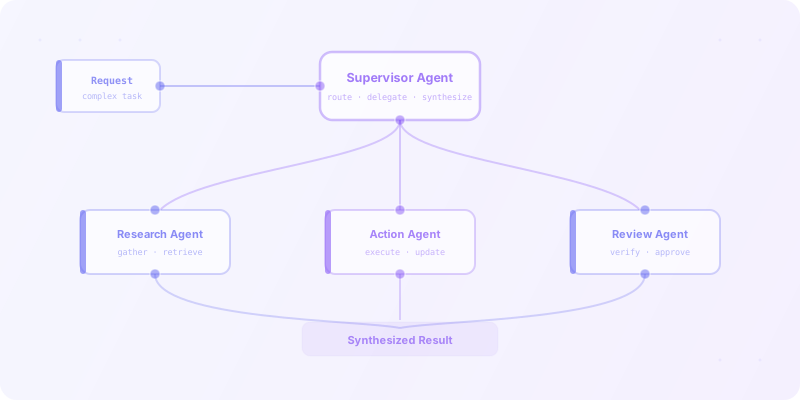
At a glance
AI agent orchestration is the coordination layer that lets several specialized agents collaborate on a job that exceeds any single agent — a supervisor or router delegates subtasks, a shared state keeps context, and results are synthesized into one outcome. SmartFlow designs, builds, and supports these multi-agent systems, choosing the right pattern and platform per engagement (we work across n8n, LangGraph, and models from Anthropic, OpenAI, and Google) with governance and observability built in.
What we design, build & support
The full coordination layer — from architecture to production observability.
Orchestration patterns we build
We match the pattern to the work rather than forcing one blueprint.
Example orchestration use cases
- End-to-end support resolution: a router sends each ticket to a billing, technical, or account specialist agent, with a supervisor handling escalations
- Lead-to-close pipelines where research, outreach, and CRM-update agents hand work down the line
- Document processing at scale: extract, validate, and file agents split a high-volume queue and flag exceptions
- Back-office close: reconciliation, categorization, and review agents coordinate under a supervisor with a human sign-off
- Research and reporting: parallel gather agents feed a synthesis agent that produces a single reviewed output
- Complex operations where one agent's context window or toolset isn't enough for the whole job
Do you need orchestration?
Multi-agent systems are powerful but add complexity. We start with the simplest thing that works and add coordination only when the job demands it.
- A single agent's context or toolset can't hold the whole job
- The work splits cleanly into specialties that benefit from focused agents
- Different request types need different handling and routing
- You need parallelism or a review step to hit quality and speed targets
- The process is valuable enough to justify the extra coordination and observability
- One well-scoped agent already handles the task reliably
- The added coordination cost and complexity aren't yet justified
- Latency and token budgets are tight — more agents means more calls
- The team is still validating that a single agent earns trust in production
AI agent orchestration FAQ
What is AI agent orchestration?
Orchestration is the coordination layer that lets multiple AI agents work together on a task that's too big for any one of them. Instead of a single agent doing everything, a supervisor or router delegates subtasks to specialized agents, shares context between them, and pulls the results back together — with the retries, timeouts, and escalations that keep the whole system reliable.
Why use multiple agents instead of one?
Splitting work across specialized agents keeps each one's context focused and accurate, which improves reliability on complex jobs. It also lets you route different request types to the right specialist, run steps in parallel for speed, and add review steps for quality. The trade-off is added complexity — orchestration logic, shared state, and observability — which is why it's worth doing only when the job genuinely exceeds a single agent.
Which orchestration patterns do you build?
The common ones: supervisor-and-workers (a lead agent delegates and synthesizes), router/dispatcher (classify and forward to a specialist), sequential pipelines (each agent builds on the last), and parallel or evaluator setups (agents work simultaneously, or one critiques another). We choose the pattern that fits the work rather than applying one blueprint to everything.
Which platforms and models do you orchestrate with?
We're platform-agnostic. We build coordination layers on tools like n8n and LangGraph, using models from Anthropic (Claude), OpenAI (GPT), and Google (Gemini) — often mixing models so each agent runs on the one best suited to its job and budget. The right choice depends on integration needs, data privacy, latency, and cost, which we assess per engagement.
How do you keep a multi-agent system safe and cost-controlled?
Each agent gets only the permissions it needs, consequential actions require human approval, and everything is logged for a full audit trail. On cost and reliability, we instrument every agent and hand-off, set timeouts and hard stops to prevent runaway loops, and monitor token spend — tuning routing so simple requests don't pay for unnecessary agent calls.
What does an orchestration engagement cost?
Every engagement is fixed-price after a discovery call. Multi-agent systems are scoped by the number of agents, the integrations involved, and the governance required — typically a four to five-figure build, with ongoing support and tuning on monthly retainer tiers. We often start with a single agent and add orchestration once it's clearly needed. Start with a free automation review for an estimate.
New to agents? Start with AI Agent Development and add orchestration when one agent isn't enough.
Have a process that needs a team of agents?
We'll help you decide whether orchestration is warranted and, if so, design a system that stays reliable and accountable.