AI Agent Development
Design, Build & Support
An AI agent is software that uses a language model to pursue a goal — it reasons, calls your tools, takes action, and checks its own work, with minimal hand-holding. We design, build, and support custom AI agents that do real work across the systems your business already runs.
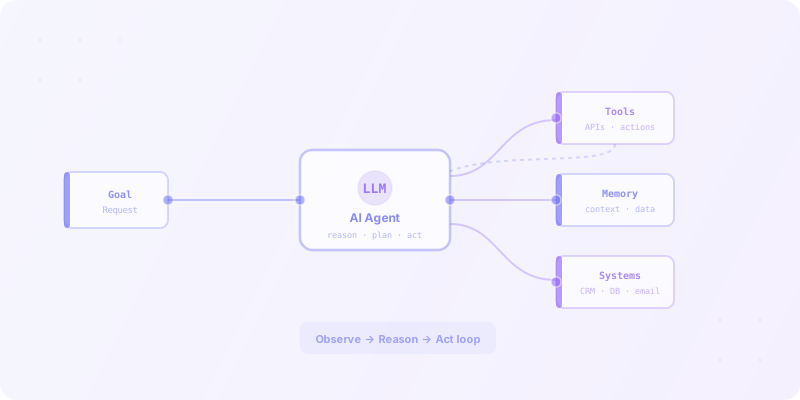
At a glance
An AI agent, or agentic AI, pairs a language model with tools, memory, and access to your systems so it can complete multi-step tasks — not just answer questions. It acts as a second brain for your business — reasoning over your tools and taking action. SmartFlow designs, builds, and supports custom agents, choosing the right model and platform for each job (we work across n8n, LangChain, and models from Anthropic, OpenAI, and Google) and wrapping every agent in guardrails, approvals, and monitoring so it is safe to run against your live business.
What we design, build & support
A complete engagement — from scoping the agent's job to keeping it healthy in production.
Example AI agent use cases
- Customer support agents that verify an account, diagnose the issue, take the fix, and close the ticket
- Sales development agents that qualify inbound leads, enrich records, and schedule the right follow-up
- Finance agents that reconcile invoices against purchase orders and flag mismatches for review
- Operations agents that triage requests, update systems of record, and route exceptions to a person
- Research agents that gather, summarize, and classify information across your tools and the web
- Document agents that read, extract, and file structured data from PDFs, emails, and forms
Is an AI agent the right fit?
Agents shine on judgment-heavy, multi-step work. For fully predictable processes, a plain automation is often the better tool — and we'll tell you so.
- The task requires judgment or reasoning, not just a fixed rule
- The work spans several tools and steps that change case to case
- Volume is high enough that manual handling is a real cost
- You can define clear guardrails and a human checkpoint for risky actions
- Good and bad outcomes are describable, so the agent can be evaluated
- The process is fully predictable and rule-based — a standard workflow is cheaper and more reliable
- There is no tolerance for occasional model error, even with review
- The task runs rarely and is fast to do by hand
- The data or action isn't yet accessible through an API
AI agent FAQ
What is an AI agent, and how is it different from a chatbot?
A chatbot answers questions and generates text. An AI agent uses a language model to plan and carry out a goal — it decides which steps to take, calls tools and systems to get information and perform actions, observes the result, and iterates until the job is done. In short: a chatbot talks; an agent acts.
Which AI models and platforms do you build on?
We are platform-agnostic on purpose. We build agents on tools like n8n's AI Agent nodes and LangChain/LangGraph, using leading models from Anthropic (Claude), OpenAI (GPT), and Google (Gemini). We pick the model and platform per engagement based on accuracy, cost, data-privacy needs, and how the agent has to integrate — rather than locking you into one vendor.
How do you keep an AI agent from doing something wrong?
Guardrails are part of the design, not an afterthought. High-stakes actions require human approval, permissions are scoped to only what the agent needs, every action is logged, and the agent falls back to a person on anything ambiguous. We start the agent in a narrow, low-risk lane and widen its autonomy only as it earns trust against real cases.
Do we need to replace our current tools to use an AI agent?
No. Agents work best layered on top of the systems you already run. We connect the agent to your existing CRM, accounting, help desk, and databases through their APIs. The goal is to remove manual handoffs between those tools, not to rip them out.
What does an AI agent engagement cost?
Every engagement is fixed-price after a short discovery call. A first production agent — scoped to a specific job, wired into your tools, with guardrails and monitoring — typically lands in a four to five-figure range, with ongoing support and expansion offered on monthly retainer tiers. Start with a free automation review for a precise estimate.
Coordinating several agents on one process? Explore AI Agent Orchestration.
Ready to put an AI agent to work?
Whether you have a specific job in mind or just want to know where an agent could help, we can map it out with you.