IT Services (MSP) · n8n, Cisco Meraki, SyncroMSP
Recovering 20 Hours a Week by Auto-Closing Resolved MSP Tickets
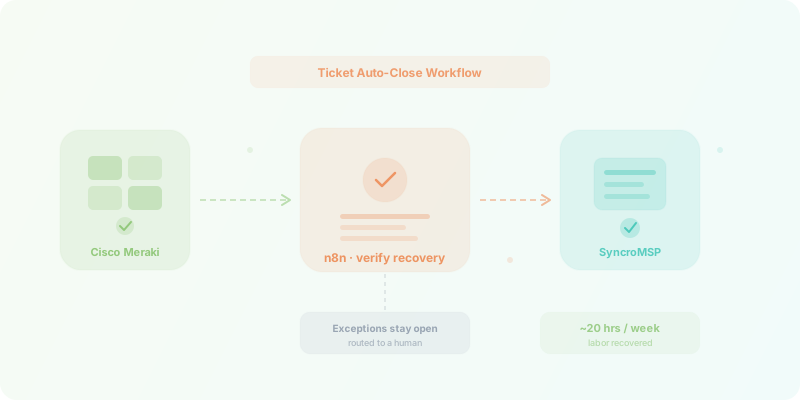
An IT services firm was losing roughly 20 hours a week manually closing Cisco Meraki alerts for devices that had already come back online. An n8n workflow now bridges Meraki and SyncroMSP — confirming each device is genuinely healthy and closing the ticket automatically.
Labor recovered
~20 hrs/week
Systems bridged
Meraki -> SyncroMSP
Ticket closure
Automated
The Problem
Cisco Meraki is very good at telling you when something goes offline — a switch drops, an access point stops responding, an uplink flaps — and that alert becomes a ticket in SyncroMSP immediately. The trouble is what happens next. Most of these alerts resolve on their own: a device reboots after a power blip, a circuit recovers, an AP reconnects. Meraki knows the device is healthy again; SyncroMSP does not, so the ticket sits open waiting for a human. Every day, technicians worked through a queue of tickets that were already resolved — open the ticket, look up the device in Meraki, confirm it came back up, add a note, close it, repeat. Each took only a minute or two, but the volume made it expensive: hours lost daily to triage that produced no client outcome, a queue that misrepresented reality, alert fatigue, and skilled technicians doing clerical work instead of project work. The task was too simple to justify a person and too frequent to ignore.
Our Approach
- Listen for Meraki recovery alerts — trigger the moment a previously-down device reports operational again
- Match the recovered device to its corresponding open ticket in SyncroMSP
- Verify the device is genuinely healthy by confirming current state, rather than trusting a single alert
- Write a resolution note recording the outage window and confirmed recovery, then close the ticket automatically
- Leave anything that doesn't meet the criteria open and routed to a human — exactly as before
The Outcome
Approximately 20 labor hours per week were returned — the equivalent of half a full-time position, recovered without adding headcount. The open queue tells the truth again, so tickets that genuinely need a person surface faster. Resolution notes are consistent and complete — often more so than notes written by hand at the end of a long day — and technicians are back on project delivery and client-facing work instead of clerical triage.
The Takeaway
The most expensive inefficiencies in an IT services business are rarely the complicated ones. They are the small, repetitive tasks no one questions because each instance takes only a minute. Two systems that don't talk to each other, and a task simple enough to describe in one sentence, is the profile of a problem worth automating.
Want similar results?
Start with a free automation review. We will identify the highest- impact opportunities in your current workflow.